





Myanmar Delicacies
Myanmar Daily Food
Every country has its own customs and traditional food. Myanmar has a variety of traditional food. Our staple food is rice and curry daily. We still serve our dishes the same way our ancestors serve them. In Myanmar, rice, meat, fish and prawn curries are serve as main dishes while fried- vegetables salads, soups, and boiled or raw vegetables eaten with fish sauce are eaten as side-dishes.
While Myanmar cook delicious curries at home we also go to restaurants to eat. Nowadays, Myanmar restaurants prepare curries, which are appreciated by tourists, and restaurants are decorated accordingly to International décor. Some of the shops are decorated with traditional Myanmar decor. So, customers can enjoy the food and admire the Myanmar arts at the same time. And nowadays, foreign entrepreneurs and tourists who happen to visit Myanmar enjoy Myanmar curries served in our restaurants. Because Myanmar is rich in natural resources, it is easy to obtain fresh meat, fish and vegetables. Thus, we can provide our guests with delicious curries that you can enjoy to your heart's content.
Myanmar Traditional Snacks
Myanmar nationals enjoy rice and curry as our staple food but we also use to take local snacks as desserts and food other than our main meal.Most of Myanmar local snacks such as steamed glutinous rice, Beinmoun, Khaukmoun, Mounpyathalet and Mounlonyepaw and Mounlakepya, are made of rice and glutinous rice. Some of the Myanmar snacks are prepared beforehand and some are done instantly for enjoyment. This is instant preparation of Olay Beinmoun or small poppy seeded pancake baked in small pots. Ordinary rice and glutinous rice are mixed together in a grindstone to obtain batter for preparation of small pancakes. The batter is then mixed with pounded garlic, onion and ginger for fragrance. The mixture is fried with edible oil. Steamed garden pea and roasted sesame powder sprinkled on the small pancake. It becomes warm, fresh and delicious Myanmar snack with fragrance. This is baking of Beinmoun or poppy seeded pancake. A mixture of ordinary rice and glutinous rice batter is put in small pans.
A small amount of batter mixed with jaggery solution is poured on the batter in the pans. Some coconut chips and poppy seeds are garnished. The pans are heated by fire placed on and under them. Some edible oil is soared to keep the pancake not to be sticky on the pan. Then you can have sweet and tasty pancake. Similarly we can prepare Htawbat Beinmoun or butter pancake. Instead of edible oil, butter is applied for its fragrance. Mounpyathalet or honeycomb pancake is also baked as Beinmoun but, instead of batter with jaggery solution, steamed garden pea, roasted sesame powder and onion are added. It is a delicious Myanmar snack.
This is preparation of Khaukmoun or folded pancake. Put the batter in a small flat pan and spread it as large as the size of the pan. Add jaggery solution; garnish steamed garden pea and coconut chips. Cover the pan. After baking the pancake, fold it in the middle. Then you will have the pancake which will give you sweat smelling of jaggery. Likewise, you can prepare Khaukmounpyu or white folded pancake. Add tomato, coriander, cabbage, green chilli and curry powder instead of jaggery solution. The snack will give you multiple tastes. These delicious Myanmar snacks are sold at grand food stalls. The tasty traditional snacks are liked by Myanmar nationals as well as by foreigners
Pickled Herbal Tea Leaves of Myanmar
Have you ever closely seem sprouts of tealeaves with green and brownish colour? You will be interested in the tealeaves if you have seen once. Because if you have ever chewed the green sprouts of tealeaves you will feel it's significant tastes. It has a mixed taste of light sweet and bitter. These tealeaves are also a kind of herbal leaves and largely grown in Palaung Hills in North east of Myanmar. The tea leaves like cool weather thriving at a place of high and shady trees at a place of 4 thousand feet high above sea level. The tea sprouts are harvested between April and October every year. Two leaves and a sprout at the top of the tea plant are plucked gently. Tea leaves plucked before April are the best.
After plucking the tealeaves, they are kept in open air to keep away from heat. Later, the tealeaves are put in an oven and steamed for 5 minutes. Then, the tealeaves are spread on a short table and rolled by a team of worker. Rolled tealeaves filled big baskets in no time by collective work of Palaung youths. Plastic sheets are spread in the baskets to save the tealeaves from softening and getting rot. And then stones are put on the leaves for tenderising. After tenderising for 2 days, the pickled tealeaves are sieved for separation of tender and rough leaves. Rough leaves are cut and then mixed with tender leaves. Then the pickled tea becomes marketable for sale.
Young and old in Myanmar fond of the pickled tea, which is a traditional delicacy. The pickled tea, mixed with fried garlic, sesame and groundnut, is served at merit sharing ceremonies and weddings. It depicts friendship and hospitality. We invite you to visit our hill ranges where tea is grown. We will entertain you with a plate of delicious pickled tea, which is rich in mixed light sweet and bitter tastes.
Myanma Green Tea
Myanmar national's green tea chat is very important occasion when family and relatives gather intimately. Friendliness, collectiveness and intimacy are the mainstay of built into this kind of chat. Tea plants mostly grown in the Shan plateau in Shan state of Myanmar which has a cool climate. Several national races of Myanmar live there. Palaung nationals earn their living by producing dried tealeaves in Shan plateau. Leaves and sprouts of plain tea, cultivated in Shan plateau, are picked and made into various tea products such as pickled tea and dried tea etc.
The Palaung slopes on which the tea plants are grown in tier by tier look green and pleasant. These pants are 200 years old and native Shan national tea growers descend from generation after generation. Tea plants are named " Hofi" " Shwefioo" and " Shwefihnaung" according to the harvest time. Some plants are called Kharcantoo, Kharcantgyi and Hninthet. Plain tea leaves plucked in late April is called Shwephyimoelut and the other leaves plucked in June are called Kharcantoo. The best kind of tea is plucked in early April, which is called Shwephyioo.
First, tealeaves are spread get fresh air and then steam them with water vapour. Five minutes later, steamed green-tea leaves are laid and spread in the sun and the leaves are rolled and mixed by hands. After that, the dried tealeaves are available for green tea lovers. The leaves dried in single day are the best ones which provide good scent, taste and colour. After adding some scented dried tea into boiled water, we get a cup of aromatic cup of tea with astringent taste. Every Myanmar citizen prefers the green herbal plain tea, which has a peculiar taste of both bitterness and sweetness. So, you are welcome to join our traditional green tea talks.
Myanma Traditional Food " Pone Ye Gyi "
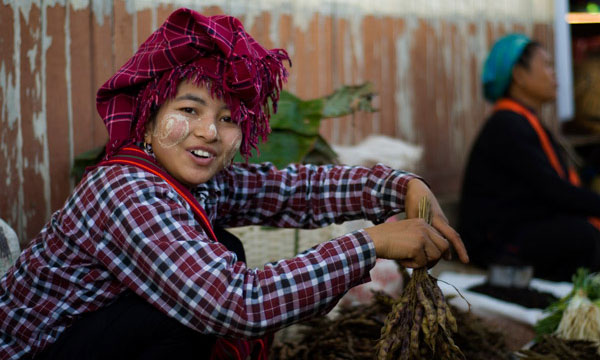
The must production of the best Pone Ye Gyi in Myanmar is in Bagan. Pone Ye Gyi is one the Myanma Traditional foods which is made from hose-gram. And it is consumed as a side-dish all over Myanmar. And it can also be used as salad mixing with chilli, onion and oil (or) it can be cooked with meat.
The process of making pone Ye Gyi, first of all, horse gram was sieved and washed. Then the cleaned horse-gram was boiled. After boiling for three hours, it is time for sieving. In order to make Pone Ye Gyi, only the liquid portions are used. So the remaining horse gram becomes animal's feedstuff. The liquid horse gram has a taste of slightly acid or some are rich in taste. If this liquid horse-gram is put into the pot for a night, it turns into a sour taste. To change the taste, no chemicals are used. It naturally changes the taste from a rich to a sour taste. To get more pure in quality, the liquid is sieved again. The remaining cleaned liquid was boiled for about 3 hours. It becomes Pone Ye Gyi when it is getting sticky. These are cooled for a night. At the packing stage, Pone Ye Gyi is packed tightly to last long. Those for dried powder Pone Ye Gyi, the cooled one are then grounded and sell as a dry powder one to last longer than the natural one.
Nipa Palm Forest
You can see a lot of Nipa palm thinning near the banks of rivers and creeks in Dawei Township. Nipa palm thrives in swamps of fresh water and sea-water where there is the ebbing and swelling of the tide. Making Nipa palm sugar that boiled from Nipa palm juice is an interesting cottage industry in Dawei Township. Making Nipa palm sugar in the suburb of Dawei Township run a cottage industry.
The process of producing Nipa palm sugar is, first the ripe Nipa palm fruits are cut off and bamboo containers are hung under their stalks the whole night to gather Nipa palm juice. Then, close the hole with mud to be firm of Nipa palm stalk and bamboo container. Early next morning, the bamboo containers full of juice are collected. The Nipa palm juice is filtered and then boiled in the large pans. When it is boiled, the float is removed to make the juice cleaner. After about three hours of boiling, the saturated juice is allowed to cool, and thus Nipa palm sugar is obtained. At the end of the process, the bamboo cubes are cleaned and fumigated by smoke for use in next day's palm juice collection. The above process is repeated everyday.
The Nipa palm sugar is very sweet therefore, it is useful in making various kinds of local snacks. The Nipa palm juice is a sweet drink in the morning, but in the late afternoon, it ferments into bitter juice, which is an intoxicant. The bitter Nipa palm juice has the same potency as alcohol. It is stronger than the bitter toddy juice. Nipa palm juice turns into local drink called "Pa Ohn Ye" after two days storage in pots. It is used as vinegar in this region. Nipa palm blossom jam is obtained when Nipa palm blossoms are plucked and cooked with Nipa palm sugar. The jam is served with green tea as a dessert. The Nipa palm products are useful for this region and those are the lucrative cottage industry.
Myanmar Jaggery
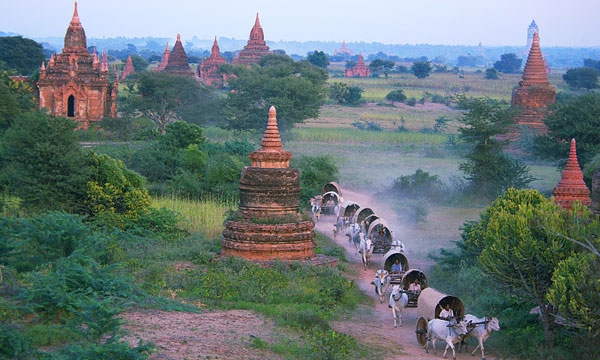
In the dry zone of upper Myanmar near the ancient city of Bagan somewhere east of the Tuyin hill, there are many small villages that depend on the toddy-palm trees for their livelihood. Together with the rising morning sun, a bullock cart sets to fetch water for their daily consumption. These goats are raised for the second income for the family. The smoke rises from the chimney of the hut where jaggery is made. And the young child prepares the earthen pots that are to be used for toddy-sap collection.
The construction of ladder about 15 feet in length is also skilfully done. Ropes made of fibres of the toddy-palm are used to secure the ladder's steps. This ladder is then drawn up to the top of the tree and fastens firmly to the middle branch. Tie the ladder in the middle is dangerous because the climber's life is entirely dependent on his left hand and his right foot. The ancestor hand down techniques and experience over generations. Another ladder about 25 feet long is carried from one tree to another in order to link up with upper one. The sap is required to make the jaggery. The first stock has to brew with the specially made iron tool to get an abundant flow.
Male-tree is treated differently with another type of specially designed wooden plant. Then it is pressed from tip to end with this instrument. And the tips are cut-off after being tied together. The sap is then collected with the earthen pot. Both processes need great experience. The bee too loves the sweet sap and is attracted to it. The women and youngsters help out on the ground with the earthen pots. Slight calcium is put into the pot to purify and prevent the sap from going sour. A climber has to climb at least 8 trees twice a day at regular periods in order to collect the sap regardless of the weather- rain, sun and wind. All the daily sap are collected and brought to the hut it is here that the jaggery is made. About 4 (or) 5 pans filled with sap are boiled down to the ratio of 10 to 1 on long stove until it becomes syrup. Approximately, 30 viss is produced everyday. A mixture of bean husk, cow dump and chip palm leaves are used to manipulate the heating temperature. When the syrup becomes thick, a large wooden spoon is used, and stirs continuously. Finally, jaggery is rolled into small lump by hand and let to solidify. After a day work in the toddy-palm forest they return to their villages. The sun goes down slowly behind the toddy trees and that ends another day for the toddy palm workers.
